
Best Water Filtration Systems: 2025 Top Picks
Compare water filtration systems using published specifications, filter stages, installation requirements, and stated contaminant-reduction claims.

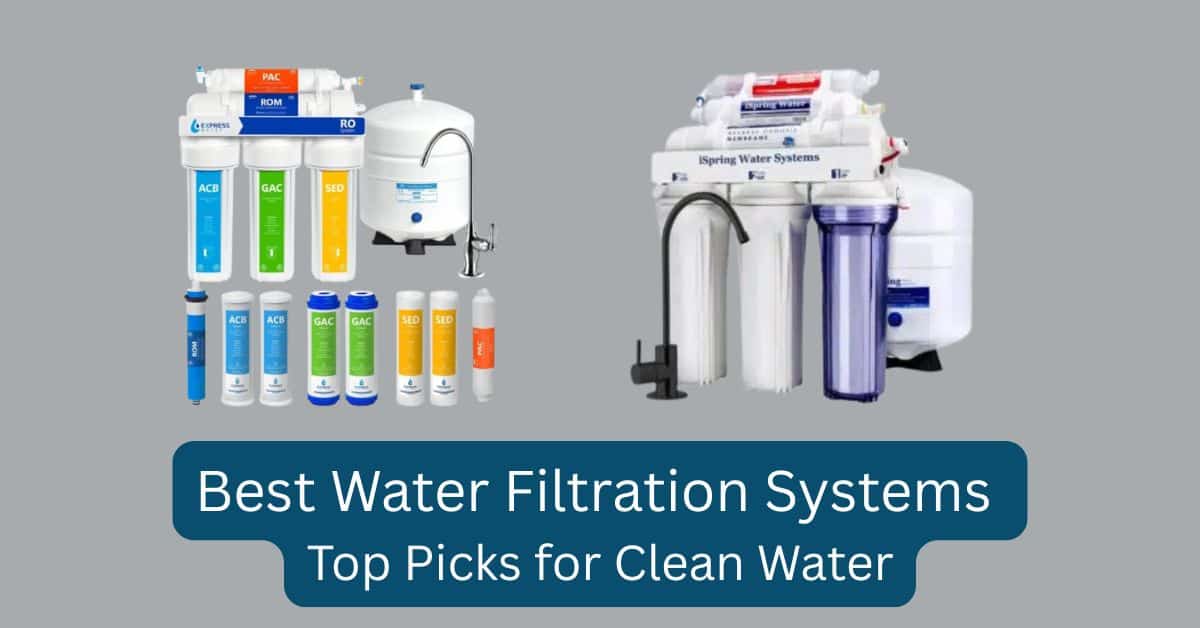
A 75-GPD under-sink reverse-osmosis system, a 400-600 GPD tankless unit, and a countertop reservoir solve different drinking-water problems. The useful comparison starts with the contaminants to reduce, then narrows by available space, plumbing, production rate, and wastewater ratio.
Choosing the right water filtration system depends on several factors. Consider the types of contaminants you need to remove—like chlorine, lead, or bacteria. The size and design of the system also matter, especially if you have limited space. Also, think about flow rate and filter lifespan to avoid frequent replacements, which can add up in cost.
With so many options on the market, finding the best water filtration system can be overwhelming. I compared published specifications, filter stages, installation requirements, and stated contaminant-reduction claims to help match each option to the right use case.
Best Water Filtration Systems
The list below compares water filtration systems by use case, filter design, maintenance needs, and manufacturer-published specifications.
iSpring RCC7AK Water Filter

Best for households that want a remineralizing under-sink reverse osmosis system with a published high-capacity tank.
Key specs: 6-stage alkaline RO (RCC7AK); 75 GPD rating; NSF/ANSI 58 certified; storage tank included; 1-year limited manufacturer warranty (iSpring – RCC7AK 6-stage 75 GPD alkaline RO system)
Pros
- 6-stage layout ends with a remineralization cartridge that adds minerals back after RO filtration
- NSF/ANSI 58 certified as a complete system
- 75 GPD rated output with a storage tank and a 1-year limited manufacturer warranty
Cons
- Requires under-sink space plus faucet and drain connections
- Filter set needs periodic replacement
- Storage tank takes up cabinet room
Waterdrop Countertop RO System

Best for renters or kitchens that need a countertop reverse osmosis unit without permanent installation.
Key specs: countertop RO; detachable refillable reservoir; marketed to reduce PFAS; no installation; 6-stage RO filtration; 3:1 pure-to-drain ratio; 11.7 x 8.3 x 13.7 in. dimensions; 1-year warranty (Waterdrop – CoreRO countertop RO system)
Pros
- Refillable detachable reservoir; no plumbing or drilling required
- Marketed to reduce PFAS along with TDS, chlorine, and lead
Cons
- Small reservoir needs frequent refills for heavy use
- Dispensing is slower than under-sink systems
- Takes up counter space while in use
WaterFirst Dr.Water Y Countertop RO Filter

Best for buyers who want a countertop RO system with a large reservoir and no permanent installation.
Key specs: 5-stage countertop RO; NSF/ANSI 58 certified; 4 L reservoir; 3:1 pure-to-drain; 1-year warranty (WaterFirst Dr.Water Y countertop RO filter – product listing)
Pros
- NSF/ANSI 58 certified countertop RO system
- 3:1 pure-to-drain ratio
- 4 L reservoir and 1-year warranty
Cons
- Reservoir needs periodic refills
- Filter and membrane replacement add ongoing cost
- Countertop footprint is larger than a pitcher system
iSpring RCC7AK-BLK Alkaline Water System

Best for kitchens that want under-sink RO with remineralization and a separate designer faucet.
Key specs: 6-stage alkaline RO (RCC7AK-BLK); 0.0001-micron membrane; NSF/ANSI 58; black faucet included; 1-year warranty with lifetime support (iSpring – RCC7AK-BLK 75 GPD alkaline 6-stage RO system)
Pros
- NSF/ANSI 58 certified 6-stage system with remineralization
- Black designer faucet included
- 0.0001-micron membrane; 1-year warranty with lifetime technical support
Cons
- Requires under-sink space and a faucet installation
- Initial flushing and setup steps are required
- Filter set needs scheduled replacement
Waterdrop G2 RO System

Best for households that want a tankless under-sink RO system with faster dispensing than many countertop units.
Key specs: tankless 7-stage RO (G2); 400 GPD; 2:1 pure-to-drain; NSF/ANSI 372; 44 × 15 × 35.5 cm (Waterdrop – G2 tankless RO system)
Pros
- Tankless 7-stage RO rated at 400 GPD
- 2:1 pure-to-drain ratio
- NSF/ANSI 372 certified in a compact 44 x 15 x 35.5 cm chassis
Cons
- Requires an electrical outlet and drilling for the faucet
- Filter set needs periodic replacement
- Tankless design needs a supply line with adequate pressure
The tankless layout is its main differentiator, making it a stronger fit for kitchens where cabinet space is limited.
Santevia Gravity Water System

Best for buyers who want a gravity-fed countertop system with remineralization media and no electricity use.
Key specs: gravity countertop system; 10 L (2.6 gal); adds calcium, magnesium, potassium; manufacturer states a pH increase of 1.5-2.0 units; no electricity; 90-day warranty (9GS-101) (Santevia – Gravity Water System; Santevia support – pH increase)
Pros
- Gravity-fed operation needs no electricity or plumbing
- 10 L (2.6-gallon) capacity
- Adds calcium, magnesium, and potassium, with a stated pH increase of 1.5-2.0 units
Cons
- Filtration is slow compared with pressurized systems
- Filter media needs periodic replacement
- 90-day warranty on the countertop model (9GS-101) (Santevia – warranty and refund policy)
Express Water – Alkaline Water System

Best for under-sink buyers who want alkaline remineralization and a conventional storage-tank RO layout.
Key specs: ROALK5D alkaline RO; 4-gallon tank (3.2-gallon water capacity); 0.8 GPM delivery faucet; operates at 40-80 psi; 1-year warranty (Express Water – ROALK5D Alkaline RO System)
Pros
- Alkaline remineralization stage follows RO filtration
- 4-gallon storage tank (about 3.2-gallon water capacity)
- 0.8 GPM delivery faucet; operates at 40-80 psi; 1-year warranty
Cons
- Storage tank and filter housing need under-sink space
- Produces wastewater during production
- Filter set requires periodic replacement
FRIZZLIFE Water Filtration System

Best for compact kitchens that want tankless under-sink filtration with an LED status display.
Key specs: tankless RO (PX600); 600 GPD; flow about 0.42 GPM; 11-stage; manufacturer states testing to NSF/ANSI 42, 53, and 58 and IAPMO R&T certification to NSF/ANSI 372; 2:1 pure-to-drain (Frizzlife – PX600; Frizzlife PX600 spec leaflet (PDF))
Pros
- Tankless 11-stage RO rated at 600 GPD (about 0.42 GPM)
- Tested to NSF/ANSI 42, 53, and 58 protocols, with IAPMO R&T certification to NSF/ANSI 372 for low lead
- 2:1 pure-to-drain ratio
Cons
- Requires an electrical outlet and under-sink space
- Filter packs need scheduled replacement
- Installation involves faucet and drain connections
Its feature list centers on 11-stage filtration, LED status monitoring, and a faster dispensing profile than many countertop systems.
Express Water RO5DX System

Best for buyers who want a conventional under-sink RO kit with color-coded connections and replacement filters included.
Key specs: RO5DX 5-stage RO; 17” × 15” × 5” chassis; about 31 lb; manufacturer’s listed rating is up to 99.99% reduction of lead, chlorine, fluoride, nitrates, and arsenic; 1-year warranty (Express Water – RO5DX Reverse Osmosis System)
Pros
- 5-stage RO with color-coded tubing and a filter set included
- Compact about 17” x 15” x 5” chassis at about 31 lb
- Manufacturer states up to 99.99% reduction of lead, chlorine, fluoride, nitrates, and arsenic; 1-year warranty
Cons
- Storage tank and housings take up under-sink space
- Produces about 3-4 gallons of wastewater per gallon of pure water per the manufacturer
- Filter set needs yearly replacement
The published design favors DIY-minded installation, but buyers still need enough cabinet space and should expect routine filter service.
Frizzlife Countertop RO System

Best for renters or small kitchens that want countertop RO with a removable tank and TDS display.
Key specs: countertop RO (WB99); NSF/ANSI 58 elements; 0.0001-micron membrane; 100 GPD membrane rating; 4.5 L removable tank; 3.5:1 pure-to-drain (Frizzlife – WB99 countertop RO system)
Pros
- Countertop RO with NSF/ANSI 58 certified elements
- 0.0001-micron membrane with a 100 GPD rating
- 4.5 L removable tank with 3.5:1 pure-to-drain ratio
Cons
- Needs counter space and a power outlet
- Filter and membrane replacement add ongoing cost
- Reservoir must be refilled between uses
Buying Guide
Most of the picks above are reverse osmosis systems, and the real decision is less about filter type than about format and capacity. Under-sink units with a storage tank, like the 6-stage iSpring RCC7AK rated at 75 GPD, hold filtered water in reserve between uses; tankless models such as the Waterdrop G2 and Frizzlife PX600 skip the tank and dispense straight from the membrane at 400-600 GPD, which matters more if more than one tap draws water at the same time. Countertop units like the Waterdrop CoreRO, WaterFirst Dr.Water Y (4 L reservoir), and Frizzlife WB99 (4.5 L removable tank) need no plumbing or drilling but rely on that reservoir being refilled by hand. Stage count across these systems ranges from 5 to 11, and membrane fineness goes down to 0.0001 micron on a couple of them, but the pure-to-drain ratio — as tight as 2:1 on the tankless units versus 3.5:1 on the Frizzlife WB99 — tells you how much water each system wastes to produce the water you actually drink, and an NSF/ANSI 58 certification backs up an RO system’s claims about the contaminants it reduces.
Capacity and Speed
The tank-based iSpring RCC7AK produces 75 GPD and stores water between uses, while the Waterdrop G2 and Frizzlife PX600 dispense at 400-600 GPD without a storage tank. Countertop models instead limit each run to reservoirs of roughly 4 to 4.5 litres.
Installation and Maintenance
Countertop units avoid drilling and plumbing but require manual reservoir refills. Under-sink and tankless systems use a permanent water connection, so compare the installation space with each model’s filter-change clearance and replacement schedule.
Certification
For reverse osmosis, an NSF/ANSI 58 certification provides a specific basis for checking contaminant-reduction and construction claims. Read the certified model and claim rather than treating a general safety mark as proof of every advertised reduction.
Cost
Compare replacement filters and rejected-water volume alongside the purchase price. The tankless systems listed here reach a 2:1 pure-to-drain ratio, while the Frizzlife WB99 is listed at 3.5:1, so water use is part of the ownership cost as well as filter life.
| Feature | Considerations |
|---|---|
| Type | Charcoal, Reverse Osmosis, UV |
| Capacity | Family size needs |
| Installation | DIY vs. Professional |
| Certification | Tested for safety |
| Cost | Initial & Long-term |
The best format is the one that meets the required production rate without forcing an impractical refill, plumbing change, or drain-water trade-off.
Frequently Asked Questions
When comparing water filtration systems, focus on performance, cost, and the specific contaminants you need to address. Each option has strengths, so the right fit depends on your water source and installation limits.
How do tank-based, tankless, and countertop RO systems differ in daily use?
A tank-based unit stores treated water for short bursts of demand, whereas a 400-600 GPD tankless model filters as the tap runs. A countertop RO system avoids a permanent connection but makes its 4- to 4.5-litre reservoir the practical limit between refills.
How do whole house water filtration systems compare in efficiency and cost?
Whole-house systems filter water at the source, so they are usually better suited to larger households that need treatment at multiple fixtures. They cost more up front but may reduce wear on appliances and plumbing when the water issue affects the entire home.
Which water filters remove the highest number of contaminants?
Reverse osmosis systems are known for broad contaminant reduction, including many heavy metals and dissolved chemicals. Activated carbon filters, including pitcher and cartridge systems, are more commonly used for chlorine and some volatile organic compounds.
Which is more beneficial for health: reverse osmosis systems or standard filtration methods?
Reverse osmosis is often the stronger choice when maximum contaminant reduction matters most. Standard filtration methods may preserve more minerals, so the better option depends on whether contaminant removal or mineral retention is the higher priority.
What should I look for in a water purifier pitcher to ensure effective water quality improvement?
For water purifier pitchers, look for activated carbon media, clear contaminant certifications, and a filter lifespan that matches your usage. Capacity and handling design also matter because they affect convenience and long-term cost.
What are the recommended water filtration options for well water to ensure safety and taste?
Well water often requires more robust filtering solutions. A whole-house system combined with a water softener or UV purifier is common when the water contains sediment, bacteria, hardness, or other treatment-specific contaminants.

Thomas Peterson
Owner WSA
About the Author
Latest Posts
Born and raised in Nanaimo on Vancouver Island. Thomas gained a deep appreciation for the importance of clean, reliable water. With over 15 years of experience working with water treatment systems, Thomas has become a trusted expert in helping local homeowners and businesses resolve the unique challenges of well water across the Island.
From hard water and iron buildup to low water pressure and sediment issues, Thomas takes a practical, no-nonsense approach to solving water problems. Whether it’s installing filtration systems or troubleshooting well pump issues, Thomas focuses on long-lasting solutions that help people get the clean, safe water they need.
As a proud local professional, Thomas is dedicated to serving his community with honesty, quality service, and expert advice tailored to the water conditions of Vancouver Island.
Areas of Expertise: Well Service, Well Pumps, Water Filtration Systems
- Clack Water Softener Alternatives: Top Systems for Hard Water Treatment in 2025 November 8, 2025
- Best Well Water Test Kit Options for Safe Home Water Testing in 2025 November 5, 2025
- Best Well Water TDS Meter for Accurate Home Testing in 2025 November 1, 2025
- Best Well Water Sediment Filter Systems for Clean Home Water in 2025 October 29, 2025
- Best Well Water Saltless Water Softener Systems for 2025 October 26, 2025
Facebook Twitter LinkedIn Instagram Reddit
Fact Checked & Editorial Guidelines
Our Fact Checking Process
I prioritize accuracy and integrity in my content. Here’s how I maintain high standards:
- Expert Review: All articles are reviewed by subject matter experts.
- Source Validation: Information is backed by credible, up-to-date sources.
- Transparency: I clearly cite references and disclose potential conflicts.
Your trust is important. Learn more about my fact checking process and editorial policy.
Reviewed by: Subject Matter Experts
Our Review Board
My content is carefully reviewed by experienced professionals to ensure accuracy and relevance.
- Qualified Experts: Each article is assessed by specialists with field-specific knowledge.
- Up-to-date Insights: I incorporate the latest research, trends, and standards.
- Commitment to Quality: Reviewers ensure clarity, correctness, and completeness.
Look for the expert-reviewed label to read content you can trust.