
Best Water Softener for Well Water Treatment in 2025
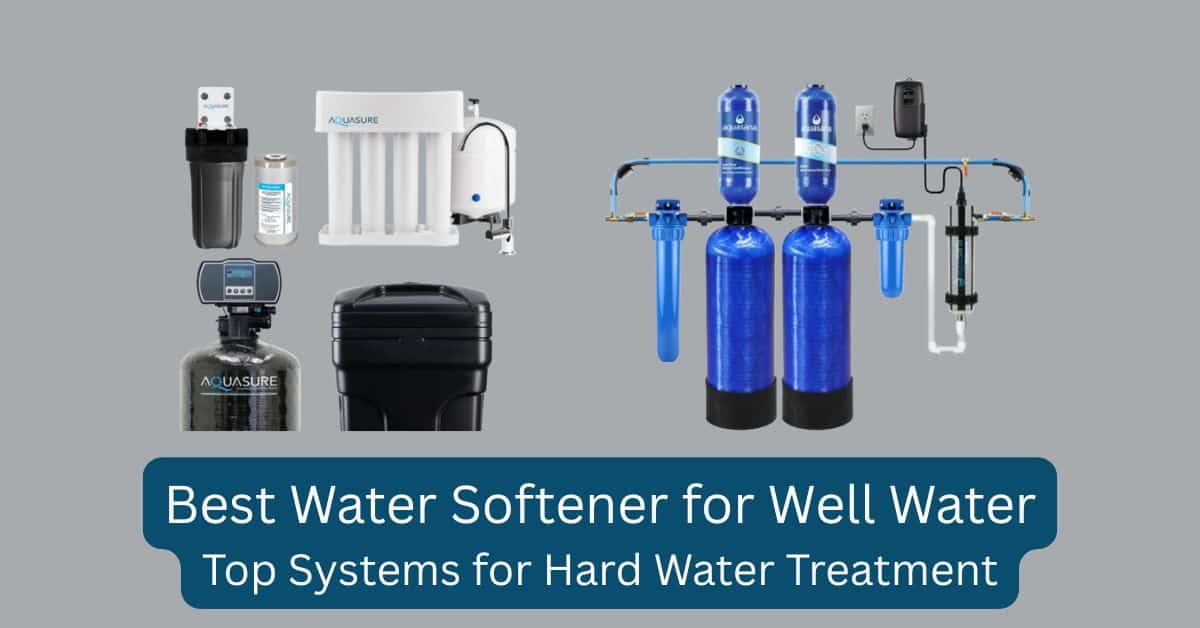
Discover the best water softener for well water in 2025. Compare the best systems to treat hard water and protect your plumbing and appliances.

Affiliate disclosure: Some links on this page are affiliate links. If you click an affiliate link and make a purchase, I may earn a small commission at no extra cost to you. I only recommend products I believe are useful to readers.
Calcium and magnesium make well water hard; a salt-based softener exchanges those ions rather than filtering particles out. The system therefore has to be sized for both hardness load and any clear-water iron the resin will encounter between regenerations.
It also makes soap less effective and can leave your skin feeling dry after bathing. A water softener removes these minerals through a process called ion exchange.
The system replaces calcium and magnesium ions with sodium ions, making the water “soft.” Water softeners designed for well water need extra features to handle the unique challenges that come with private wells, including higher mineral levels and potential contaminants like iron and sulfur.
When choosing a water softener for well water, grain capacity is the most important factor to consider. This determines how much hardness the system can remove before it needs to regenerate.
You should also look at the regeneration type, whether it handles iron removal, and the system’s flow rate to ensure it meets your household’s water demands. I compared manufacturer specifications, treatment methods, maintenance requirements, and published product information to identify strong options for well water systems.
Best Water Softeners for Well Water
Below is my complete list of the best water softeners for well water. I compared published specifications, treatment methods, maintenance requirements, and stated capacity to help match each option to the right use case.
These picks are organized to help you compare the right softener for your home’s well water needs.
Aquasure Harmony 48,000 Grain Water Softener

Best for larger homes that need reliable softening and filtration in one unit.
Key specs: 48,000-grain capacity; maximum flow rate listed at 12 GPM; 10” × 62” fiberglass-lined polyethylene tank; digital metered control head; 5-year extended manufacturer warranty when the product is activated online within 60 days (Aquasure Harmony Series 48,000 grain softener – manufacturer’s listing)
Pros
- Digital control head makes programming and monitoring simple
- Built-in pre-filter removes chlorine and sediment along with hard minerals
- Strong construction with fiberglass-lined tank handles well water conditions
Cons
- Heavy weight makes installation challenging without help
- Takes up significant floor space in utility rooms
- Pre-filter requires regular replacement which adds ongoing costs
Aquasana SimplySoft 40,000 Grain

Best for well water homes.
Key specs: 40,000-grain capacity; peak flow rate 15.5 GPM; maximum operating pressure 125 psi; IAPMO certified to NSF/ANSI 44 and CSA B483.1; 5/10-year limited warranty (Aquasana – SimplySoft 40,000 Grain Water Softener)
Pros
- Uses less salt and water than standard softeners
- Works well with both city and well water sources
- LCD display makes operation simple and clear
Cons
- Pre-filter sold separately adds to total cost
- Takes up significant space in utility areas
- Limited customer reviews make reliability hard to judge
AO Smith Whole House Descaler

Best for preventing scale buildup.
Key specs: rated for 600,000 gallons or 6 years; 6-year limited warranty (A. O. Smith – AO-WH-DSCLR owner’s manual, PDF); no cleaning, backwashing, salt bags or electricity required; 76 × 23.5 × 23.5 cm (about 30” tall) cabinet (A. O. Smith AO-WH-DSCLR manufacturer’s listing)
Pros
- No ongoing costs for salt bags or electricity usage
- Simple installation with all mounting hardware included
- Six-year warranty provides solid long-term protection
Cons
- Doesn’t remove minerals that cause actual water hardness
- Limited to moderate hardness levels under 15 grains per gallon
- Won’t help with sulfur or iron problems common in well water
iSpring 45K Grain Whole House Water Softener

Best for homes with moderate to heavy mineral content.
Key specs: 45,000-grain capacity; 1” NPT inlet/outlet; automatic backwash and media regeneration; 1-year limited manufacturer warranty with lifetime free technical support (iSpring – WCS45KG Whole House Water Softener)
Pros
- Rated to reduce hardness minerals in homes that need a 45,000-grain ion-exchange system
- Takes up minimal floor space with its tall, narrow design that fits in most utility rooms
- Automatically calculates salt usage and regeneration cycles to save money on supplies
Cons
- Programming the control panel can be confusing without reading the manual thoroughly
- Salt refills are needed more often than expected with very hard well water
- Installation requires basic plumbing skills and may need professional help for some homeowners
Aquasana Whole House Well Water Filter

Best for well water homes with moderate hardness levels that need UV sterilization and salt-free scale prevention.
Key specs: the listing for this Pro Kit (EQ-Well-UV-PRO-AST) states a 500,000-gallon capacity; flow rate 14.7 GPM; carbon and KDF filtration media with UV; salt-free scale control (Aquasana EQ-Well-UV-PRO-AST – manufacturer’s listing)
Pros
- UV light effectively kills bacteria and viruses that commonly contaminate well water
- Salt-free technology prevents scale buildup without adding sodium to your water
- Multi-stage filtration handles many contaminants while keeping healthy minerals
Cons
- Only works for water with hardness under 15 grains per gallon
- Large system requires significant space and professional installation
- Higher upfront cost compared to basic salt-based softeners
APEC SOFTENER-HE-30-FG

Best for smaller homes while using less salt and water than most competitors.
Key specs: rated for max hardness of 30,000 grains and 1-3 bathroom homes; peak flow rate 17.6 GPM; feed water temperature 34-110 °F (APEC Water – Hydro Express SOFTENER-HE-30-FG)
Pros
- Digital control valve lets you customize settings to reduce salt and water waste
- Removes existing scale buildup from pipes and appliances over time
Cons
- Only handles 1-3 bathrooms so larger homes need a bigger system
- Takes up significant floor space at 33 x 14 x 14 inches
- Initial setup requires some plumbing knowledge or professional help
AFW Filters Pentair 5600sxt-48k Water Softener

Best for well water homes with its upgraded resin and digital controls.
Key specs: 48,000-grain capacity; 1.5 cu ft of 10% crosslink resin; 10” × 54” mineral tank (62” total installed height); brine tank with 250 lb salt capacity; 1” NPT inlet/outlet; Fleck 5600 SXT valve (AFW Filters Fleck 5600 SXT 48K softener – manufacturer’s listing)
Pros
- Digital control head with simple push button programming makes operation easy
- Upgraded 10% crosslink resin handles chlorine better than standard resin
- Complete system arrives with everything needed including tanks and installation support
Cons
- 130-pound weight requires help during installation and moving
- Large size footprint takes up significant space in utility areas
- Initial setup can be complex despite included instructions
Kenmore 350 Water Softener

Best for homeowners with moderate well water hardness who need a compact unit that fits in tight spaces.
Key specs: 32,000-grain capacity; rated for hardness up to 90 gpg and clear-water iron up to 8 ppm; high flow valve; 0.83 cu ft resin tank (Kenmore 350 whole house water softener – manufacturer’s listing)
Pros
- Smart technology adjusts salt usage automatically to save money on operating costs
- Compact design fits easily in basements and small utility rooms
- Built-in screen filters out sediment to protect your plumbing and appliances
Cons
- Flow rate drops during peak usage times with multiple fixtures running
- Display board can be hard to read in dim lighting conditions
- Manual regeneration settings require more user involvement than fully automatic systems
DuraWater Fleck 5600 SXT

Best for households that want a Fleck-valve softener for moderate well water hardness.
Key specs: 48,000-grain capacity; 1.5 cu ft high-capacity resin shipped loaded in the tank; plastic bypass with 1” yoke; Fleck 5600 SXT on-demand digital metered control valve (DuraWater Fleck 5600 SXT 48,000-grain softener – manufacturer’s listing)
Pros
- Ships pre-loaded with resin so installation takes less time
- Digital metered operation only regenerates when needed
- Strong customer support helps with setup questions
Cons
- Limited to 350 PPM which rules out very hard well water
- Heavy weight makes moving it around challenging
- Manual regeneration option requires extra steps during power outages
Kind Water Systems Whole House Filter Combo

Best for homeowners who want both filtration and water conditioning in one compact unit without the hassle of salt maintenance.
Key specs: the manufacturer states a 15 GPM flow rate; reduces scale buildup by 88%; filters 95% of sediment; addresses 155+ contaminants (Kind Water Systems – Whole House Salt-Free Water Softener and Filter Combo)
Pros
- Combines water filtration and salt-free conditioning in one space-saving unit
- Uses coconut shell carbon blocks that effectively remove chlorine and chemical odors
- Handles up to 15 gallons per minute flow rate for larger homes
Cons
- Does not actually soften water like traditional salt-based systems do
- Limited customer feedback since it’s relatively new to the market
- May not address heavy mineral buildup as effectively as salt-based softeners
Aquasure Whole House Water Filtration Bundle

Best for larger homes that want softening, filtration, and reverse osmosis in one package.
Key specs: the manufacturer states a 64,000-grain softener capacity; 75 GPD reverse-osmosis output; a 0.0001-micron RO membrane rated for 99% contaminant removal; a 3-gallon RO storage tank, sized for 4-6 bathroom/up to 8-person households (Aquasure – Whole House Water Filtration Bundle)
Pros
- Handles multiple water problems at once with softening, filtering, and reverse osmosis in one package
- Digital control head automatically manages backwashing and regeneration without manual work
- Built tough with fiberglass-lined tank and comes with 5-year warranty plus lifetime support
Cons
- Takes up considerable space with multiple components throughout the house
- Installation complexity requires professional help for most homeowners
- Filter replacements every 6-12 months add ongoing costs
DuraWater Iron Eater 48K

Best for families dealing with moderate iron levels in their well water who want a reliable combination unit.
Key specs: 48,000-grain capacity; 1.5 cu ft fine mesh resin; Fleck 5600 SXT digital metered valve; softener and iron-filter combination system (DuraWater Fleck 5600 SXT 48K softener/iron filter – manufacturer’s listing)
Pros
- Tackles both hard water and iron problems in one system
- Digital valve makes programming and maintenance simple
- Fine mesh resin lasts longer than standard resin types
Cons
- Requires more installation space than single-tank alternatives
- Initial setup requires some plumbing knowledge
- Iron removal drops off when levels exceed 6 ppm
Buying Guide
For a salt-based system, the core decision is matching grain capacity to how much hardness and iron the resin has to remove between regenerations — the picks below range from 32,000 to 64,000 grains, but a higher number only helps if the resin can also handle your iron level. Standard ion-exchange resin typically manages only 3 to 5 ppm of clear-water iron before it starts fouling, which is why the DuraWater Iron Eater’s iron removal drops off once levels pass 6 ppm even though its grain capacity is high. The other variable worth deciding upfront is regeneration style, covered next: demand-initiated valves only regenerate once the meter says the resin is spent, while timer-based valves regenerate on a fixed schedule whether or not you’ve used that much capacity.
Capacity and Size
Use household demand and tested hardness to calculate capacity instead of choosing the largest label. The systems on this page range from 32,000 to 64,000 grains, and that rating describes how much hardness the resin can handle before regeneration, not whether it can tolerate unlimited iron.
Salt Type Options
Check the valve and brine-tank instructions before switching among salt pellets, crystals, or blocks. A system that accepts more than one form gives you purchasing flexibility, but the compatible type—not the cheapest bag—sets the safe choice.
Regeneration Style
A demand-initiated valve meters actual water use and regenerates when the resin’s calculated capacity is spent. A timer valve follows its calendar even after unusually light or heavy use, so its salt and water consumption is less closely tied to the hardness load.
Key Features to Compare
| Feature | Why It Matters |
|---|---|
| Flow rate | Must match your home's water usage |
| Bypass valve | Lets you bypass softening when not needed |
| Digital display | Shows system status and alerts |
| Warranty length | Protects your investment |
Flow rate controls whether pressure holds during simultaneous use, while a bypass valve keeps water available during service. A digital display makes regeneration status visible, and the warranty shows which valve, tank, and electronics remain covered after installation.
Installation Requirements
Measure room for both the resin and brine tanks, including lid clearance for adding salt. Then verify the inlet size, drain route, nearby outlet, and bypass layout; a professional installation is the safer option when those connections do not already match the selected valve.
Frequently Asked Questions
Well water presents unique challenges that require specific water softener features and maintenance approaches. Iron content, salt selection, and system design all play crucial roles in effective treatment.
How much clear-water iron can standard softener resin handle before pretreatment is needed?
Standard softener resin can typically handle about 3 to 5 ppm of clear-water iron, even though staining can begin above 0.3 ppm. Beyond the resin’s stated limit, use iron pretreatment or a combination system rather than relying on grain capacity alone.
Iron filters or combination units work best for higher iron levels. These systems use specialized media like manganese greensand or catalytic carbon to remove iron before softening.
Look for units with frequent regeneration cycles. Iron buildup requires more cleaning than standard hardness minerals.
Consider systems with pre-filtration stages. Sediment filters remove particles that can clog your softener resin.
How do water softener and filtration systems differ for well water compared to municipal water sources?
Well water systems need more comprehensive treatment than municipal water setups. City water already receives basic treatment, while well water comes straight from the ground.
Pre-filters are common in well water setups because they can remove sediment and help protect the softener media before water reaches the resin tank.
Well water often contains hydrogen sulfide, which creates a rotten egg smell. Municipal water rarely has this problem.
Testing requirements differ significantly. Well water needs annual testing for bacteria and contaminants, while city water quality reports are publicly available.
What are the advantages of a dual tank water softener system for homes with well water?
Dual tank systems provide continuous soft water during regeneration cycles. Single tank systems deliver hard water while regenerating, which can last 2-4 hours.
Dual tank setups can improve continuity in higher-demand homes because one tank can regenerate while the other remains in service.
These systems are better suited to high water usage. Large families or homes with multiple bathrooms benefit from uninterrupted soft water supply.
Dual tanks extend resin life. Less frequent regeneration reduces wear on the softening media.
What is the best type of salt to use in a water softener for treating well water?
Solar salt or evaporated salt pellets are typically preferred for well water applications because higher-purity salt leaves less residue in the brine tank.
Avoid rock salt for well water systems. The impurities in rock salt can interfere with iron removal and create maintenance issues.
Iron-fighting salt pellets work well for water with low iron content. These specialized pellets help prevent iron buildup on resin beads.
Use salt with 99.5% purity or higher. Clean salt ensures efficient regeneration and extends system life.
How do consumer reports evaluate and compare water softeners for well water?
Consumer Reports tests water softeners using standardized hard water with known mineral content. They measure removal efficiency and flow rate during testing.
Their testing doesn’t always include iron removal performance. Well water users should look for additional iron-specific testing data.
They evaluate salt efficiency and regeneration frequency. Lower salt usage and longer cycles between regeneration score higher ratings.
Build quality and warranty coverage factor into their scoring. Systems with longer warranties and durable construction receive better ratings.
Are there any specific maintenance requirements for water softeners designed for well water?
Well water softeners often need more frequent cleaning than municipal water systems. Monthly brine tank inspections and periodic cleaning can help limit residue and bacteria buildup.
Resin bed cleaning becomes essential with well water. Iron and sediment buildup requires quarterly cleaning with specialized resin cleaners.
Pre-filter replacement happens more often. Sediment filters may need changing every 3-6 months depending on water quality.
Annual water testing helps track system performance.

Thomas Peterson
Owner WSA
About the Author
Latest Posts
Born and raised in Nanaimo on Vancouver Island. Thomas gained a deep appreciation for the importance of clean, reliable water. With over 15 years of experience working with water treatment systems, Thomas has become a trusted expert in helping local homeowners and businesses resolve the unique challenges of well water across the Island.
From hard water and iron buildup to low water pressure and sediment issues, Thomas takes a practical, no-nonsense approach to solving water problems. Whether it’s installing filtration systems or troubleshooting well pump issues, Thomas focuses on long-lasting solutions that help people get the clean, safe water they need.
As a proud local professional, Thomas is dedicated to serving his community with honesty, quality service, and expert advice tailored to the water conditions of Vancouver Island.
Areas of Expertise: Well Service, Well Pumps, Water Filtration Systems
- Clack Water Softener Alternatives: Top Systems for Hard Water Treatment in 2025 November 8, 2025
- Best Well Water Test Kit Options for Safe Home Water Testing in 2025 November 5, 2025
- Best Well Water TDS Meter for Accurate Home Testing in 2025 November 1, 2025
- Best Well Water Sediment Filter Systems for Clean Home Water in 2025 October 29, 2025
- Best Well Water Saltless Water Softener Systems for 2025 October 26, 2025
Facebook Twitter LinkedIn Instagram Reddit
Fact Checked & Editorial Guidelines
The Fact Checking Process
I prioritize accuracy and integrity in my content. Here’s how I maintain high standards:
- Expert Review: All articles are reviewed by subject matter experts.
- Source Validation: Information is backed by credible, up-to-date sources.
- Transparency: I clearly cite references and disclose potential conflicts.
Your trust is important. Learn more about my fact checking process and editorial policy.
Reviewed by: Subject Matter Experts
The Review Board
The content is carefully reviewed by experienced professionals to ensure accuracy and relevance.
- Qualified Experts: Each article is assessed by specialists with field-specific knowledge.
- Up-to-date Insights: I incorporate the latest research, trends, and standards.
- Commitment to Quality: Reviewers ensure clarity, correctness, and completeness.
Look for the expert-reviewed label to read content you can trust.