
Best Well Water Sediment Filter Systems for Clean Home Water
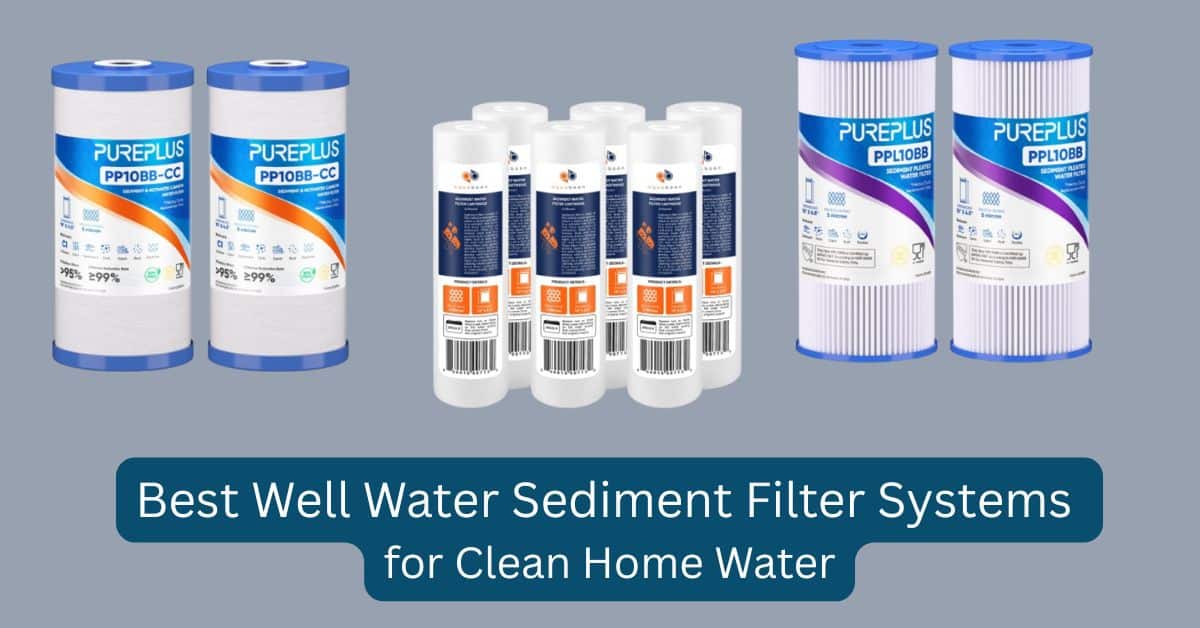
Keep your home water clean with the Best Well Water Sediment Filter Systems. Protect pipes and appliances from sediment buildup.

Affiliate disclosure: Some links on this page are affiliate links. If you click an affiliate link and make a purchase, I may earn a small commission at no extra cost to you. I only recommend products I believe are useful to readers.
Sand, silt, and rust call for different sediment stages even though they all arrive as visible particles from a private well. A coarse reusable screen protects the plumbing from heavy grit; a fine disposable cartridge catches what passes through before it reaches appliances or later treatment media.
A sediment filter removes these unwanted particles before they enter your home’s plumbing system.
Well water sediment filters are specifically designed to handle the higher sediment loads typically found in private wells compared to municipal water supplies. These filters use various materials like spun polypropylene, pleated fabric, or wound string to trap particles of different sizes.
The right sediment filter protects your water heater, washing machine, and other appliances from damage while improving the clarity and taste of your water.
The most important factors to consider when choosing a well water sediment filter are the micron rating, flow rate, and filter housing size. The micron rating determines what size particles the filter can remove, while flow rate affects water pressure throughout your home.
You also need to match the filter size to your household’s water usage and consider how often you want to replace cartridges.
Best Well Water Sediment Filters
The picks below are organized using published specifications, stated performance claims, maintenance demands, and fit for different household use cases. These picks remove sand, dirt, and rust while maintaining good water flow throughout your home.
Membrane Solutions String Wound Filters

Best for buyers who want a budget-friendly sediment filter cartridge option.
Key specs: 5-micron string-wound cartridges; 10” × 2.5”; 6-pack (Membrane Solutions listing, Amazon)
Pros
- Catches four times more dirt than standard filters and lasts longer
- Removes iron, rust, and sand particles common in well water
- Costs about half the price of name brand alternatives
Cons
- Filter height runs slightly taller than some competitors by about 1/4 inch
- May require filter housing adjustments for proper fit
- Replacement schedule depends heavily on your water quality
Waterdrop Spin Down Sediment Filter

Best for well water owners who want an effective first-stage sediment removal system with easy maintenance features.
Key specs: spin-down (backwash) filter; 50 micron; 1” MNPT + 3/4” fittings; 20 GPM flow rate (Waterdrop – WD-RPFK product page)
Pros
- The backwash cleaning feature eliminates the need to replace cartridges regularly
- Multiple connection options make installation straightforward on different plumbing setups
- The German-made housing withstands high pressure and water hammer impacts well
Cons
- The 50-micron filtering only catches larger particles and debris
- Requires manual backwash operation to clean the filter screen
- The plastic housing may not appeal to users wanting metal construction
Culligan WH-S200-C Whole House Sediment Filter

Best for homeowners who want reliable sediment removal with straightforward installation.
Key specs: WH-S200-C whole-house cartridge housing; 3/4” inlet/outlet; the listing states a 4 GPM maximum flow rate and a 16,000-gallon capacity; clear housing with pressure relief valve; NSF certified (Culligan WH-S200-C listing, Amazon)
Pros
- Clear housing lets you see when the filter needs changing
- Strong stainless steel fittings prevent leaks and corrosion
- Timer feature helps track filter replacement schedules
Cons
- Bypass valve can be extremely stiff to operate
- Threading on outlet connections may not align properly
- Battery for timer feature isn’t always included
PUREPLUS Pleated Sediment Filter

Best for well water owners who need reliable sediment removal at a good value.
Key specs: 5-micron pleated cartridge; 10” × 4.5”; 2-pack (PUREPLUS PPL10BB listing, Amazon)
Pros
- Pleated design captures dirt and particles better than basic filters
- Works with many different filter housing brands and models
- Handles up to 30,000 gallons before needing replacement
Cons
- May need changing every 3 months with very dirty well water
- Water flow slows down as filter gets clogged with sediment
- Not washable despite some marketing claims about cleanable features
PUREPLUS 5 Micron String Wound Filter

Best for households that want a standard 5-micron replacement filter at a moderate price.
Key specs: 5-micron string-wound cartridge; 10” × 4.5”; 2-pack (PUREPLUS WPX5BB97P listing, Amazon)
Pros
- Captures sediment and particles effectively with its dense honeycomb structure
- Works with many different filter housing brands and models
- Lasts longer than basic filters while maintaining good water flow
Cons
- Needs replacement every 3-6 months depending on water quality
- May clog faster in areas with very heavy sediment loads
- String wound design can be messy during filter changes
MewMore WHC40 Spin Down Filter

Best for well water owners who want a reusable system that catches sediment before it reaches their main filtration equipment.
Key specs: spin-down filter with reusable 40/100/200-micron screens; 1” MNPT + 3/4” FNPT connections; the listing states a 20 GPM max flow rate and a 14.5-145 psi working pressure range; flushable (MewMore WHC40 listing, Amazon)
Pros
- Clear housing lets you see exactly when the filter needs cleaning
- Three different mesh sizes give you options for various water conditions
- Reusable design saves money compared to disposable cartridge filters
Cons
- Drain hose feels too short for convenient flushing
- Unit is smaller than expected which may limit capacity for heavy sediment loads
- Weekly flushing required for poor quality well water adds maintenance time
SimPure Spin Down Sediment Filter

Best for homeowners who want a reliable first line of defense against sediment in their water system at a reasonable price.
Key specs: 40-micron reusable stainless-steel mesh; the listing states the bowl withstands more than 58 psi (0.4 MPa); 1” MNPT + 3/4” FNPT/MNPT connections; 3.35” × 5.75” × 10.24” housing (SimPure DC5S-40 listing, Amazon)
Pros
- Easy to clean without removing from the system thanks to the bottom flush valve
- Works effectively on both city and well water with two different filter sizes included
- Protects expensive appliances and fixtures from damaging particles
Cons
- Housing material looks like brass but isn’t solid brass construction
- Small size means it needs frequent cleaning in heavily contaminated water
- Threading connections must be purchased separately for installation
Aquaboon 5 Micron Sediment Filter

Best for buyers who want a budget-friendly multi-pack of standard sediment filter cartridges.
Key specs: 5-micron cartridges; 10” × 2.5” standard format; 6-pack (Aquaboon listing, Amazon)
Pros
- Six filters included in the pack
- Universal fit works with most standard whole house filter systems
- Strong filtration removes rust, sand, and dirt particles effectively
Cons
- May clog quickly in areas with heavy sediment loads
- Requires monthly replacement in high-sediment well water situations
- No clear window to check filter condition without removal
PUREPLUS 5 Micron String Wound Sediment Filter

Best for well water owners who need reliable sediment removal at a budget-friendly price point.
Key specs: 5-micron string-wound cartridges; 10” × 2.5”; 4-pack (PUREPLUS PPW10 listing, Amazon)
Pros
- Excellent dirt holding capacity with honeycomb structure that captures particles effectively
- Compatible with most standard 10-inch housing systems from major brands
- Good flow rate at 2.5 GPM that doesn’t slow down water pressure noticeably
Cons
- Filter life varies greatly depending on sediment levels in your well water
- String wound design can be messy to remove when heavily loaded with dirt
- Need to stock up on replacements since they require changing every 3-6 months
PUREPLUS 5 Micron Sediment Filter

Best for whole-house systems on municipal water that need a combined sediment and carbon cartridge.
Key specs: 5-micron 10” × 4.5” sediment + carbon cartridges; 2-pack; the listing states a capacity of up to 30,000 gallons; the listing states the cartridge meets EC1935-2004 food-grade material regulations (PUREPLUS PP10BB-CC listing, Amazon)
Pros
-
Installs into standard 10” x 4.5” housings without tools
-
The multi-layer design with activated carbon effectively removes chlorine taste and basic sediments Cons
-
Performance drops significantly with well water containing heavy minerals and iron
-
Filter lifespan varies greatly depending on water quality and may need frequent replacement
-
The manufacturer specifically warns this filter may not work well for well water applications
iSpring WSP-50 Spin Down Filter

Best for homes that need a reusable first-stage spin-down filter for heavier sediment loads.
Key specs: WSP-50 spin-down; 50-micron; 1” MNPT + 3/4” FNPT connections; 15-115 psi operating pressure range; lead-free brass body with reusable stainless-steel mesh (iSpring – WSP Spin Down Sediment Water Filter product page)
Pros
- Flushable design saves money on replacement cartridges over time
- Clear housing lets you see exactly when cleaning is needed
- Brass construction with stainless steel screen withstands years of use
Cons
- Limited to indoor use only due to temperature restrictions
- May clog quickly if your well water has extremely high sediment levels
- Requires manual flushing maintenance every few weeks
Rusco Spin Down Sediment Filter

Best for homeowners who want reliable sediment removal.
Key specs: Rusco/Vu-Flow T-style spin-down; 1” 100-mesh PVC body; 1-25 GPM flow capacity; 150 psi maximum pressure (Rusco/Vu-Flow listing, Amazon) (Rusco – Spin-Down Filters spec page)
Pros
- Clear housing lets you see exactly when cleaning is needed
- Simple spin-down design means no replacement filters to buy
- Sturdy PVC construction handles well water pressure without issues
Cons
- Initial installation requires some plumbing knowledge
- Only catches larger particles, not fine sediment
- Takes up more space than standard cartridge filters
SimPure DB10P Whole House Filter Housing

Best for homeowners who want a whole-house filter housing with a pressure-release button for easy cartridge changes.
Key specs: DB10P whole-house filter housing; 10” × 4.5” cartridges; 1” NPT port with pressure-release button (SimPure DB10P listing, Amazon)
Pros
- Strong reinforced construction that handles daily use without cracking or breaking
- Simple installation process with all necessary tools and mounting hardware included
- Works with many different filter cartridge brands for flexible maintenance options
Cons
- Pressure release valve can leak water even when properly installed
- Large size requires plenty of clearance space for filter changes
- Brass fittings need careful installation to avoid thread damage
Buying Guide
The clearest split among these picks is disposable cartridges versus reusable spin-down filters. Pleated and string-wound cartridges — like the PUREPLUS 5-micron pleated filter and the Membrane Solutions 5-micron string-wound filter — trap sediment permanently and get replaced whole; despite some marketing language, the pleated cartridge above is explicitly not washable. Spin-down units such as the Waterdrop WD-RPFK, iSpring WSP-50, SimPure DC5S-40, and Rusco/Vu-Flow use a coarse reusable screen or mesh — 40 to 50 micron on most, 100-mesh on the Rusco — that you flush or backwash instead of replacing, though some need flushing as often as weekly. The MewMore model is built to sit ahead of your main filtration equipment as a prefilter rather than a final stage. A finer micron rating isn’t automatically better, either: the 5-micron cartridges catch more but clog faster, with some picks needing monthly to quarterly changes in silty well water, while the 40-50 micron spin-down screens handle bigger loads but let finer particles through.
Filter Type and Micron Rating
A micron rating describes the particle size a filter catches, and lower is finer rather than automatically better. Use 50-100 microns for sand, 10-25 for rust and smaller sediment, and 1-5 only after coarser material has been intercepted.
- 50-100 microns: Remove sand and large particles
- 10-25 microns: Filter rust and smaller sediment
- 1-5 microns: Catch fine dirt and silt
Flow Rate Requirements
Match the housing and cartridge to peak household demand in the 10-20 GPM range used here. A fine cartridge that cannot pass that flow becomes a pressure restriction long before its outside looks fully loaded.
Housing Material and Size
Plastic housings lower initial cost, while stainless steel trades a higher price for greater durability. Within either material, a 20-inch housing holds more sediment than a 10-inch body and usually leaves more time between changes.
Replacement Cost and Frequency
Budget by cartridge type and sediment load: the table puts pleated media at 3-6 months, string-wound at 2-4 months, and spun polypropylene at 1-3 months. Silty wells can shorten each interval, so multi-pack price matters more than the housing’s sticker price.
| Filter Type | Replacement Frequency | Typical Cost |
|---|---|---|
| Pleated | 3-6 months | $15-30 |
| String wound | 2-4 months | $8-20 |
| Spun polypropylene | 1-3 months | $5-15 |
Installation Requirements
Confirm the port size, required adapters, and a bypass arrangement before cutting into the main line. A spin-down screen also needs access for flushing, while a cartridge housing needs enough clearance below it to remove the bowl.
Frequently Asked Questions
Most well water owners have specific questions about sediment filter performance and maintenance requirements.
These answers cover micron ratings, replacement schedules, and system maintenance needs.
Should a well use a reusable spin-down screen or a disposable fine cartridge first?
Put a 40-50 micron reusable spin-down screen first when the well carries sand or a heavy particle load, then use a 20- or 10-micron cartridge downstream. Reserve a 5-micron final stage for fine silt after the coarser material has been removed.
If your water has heavy sediment, use a 50-micron pre-filter first. Then add a 20-micron or 10-micron filter as the second stage.
For very fine particles, a 5-micron filter often works best as the final stage. It is usually better not to start with filters smaller than 10 microns unless pre-filtration is already in place.
How often should sediment filter cartridges be replaced?
Replace sediment filter cartridges every 3 to 6 months for most well water systems. High sediment wells may need monthly replacements.
Check your filter monthly by looking at the cartridge color. Replace it when it turns brown or dark gray.
Water pressure drops also signal the need for replacement. If your shower pressure decreases noticeably, check the sediment filter first.
Can a sediment filter improve the taste and odor of well water?
Sediment filters remove particles but do not improve taste or odor problems. They only filter out visible dirt, sand, and rust particles.
For taste and odor issues, activated carbon is often added after the sediment filter. Carbon media is commonly used to reduce chlorine-related taste issues and many organic compounds.
Some sediment may cause metallic tastes from rust particles. Removing these particles can slightly improve water taste.
What are the differences between a spin down sediment filter and a cartridge sediment filter?
Spin down filters use centrifugal force to separate heavy particles into a collection chamber. You flush out collected sediment by opening a drain valve.
Cartridge filters trap particles inside a replaceable filter element. You must replace the entire cartridge when it gets clogged.
Spin down filters work best for sand and heavy particles. Cartridge filters catch finer particles and provide better overall filtration.
How does a sediment filter affect water pressure and flow rate in a home?
Clean sediment filters typically reduce water pressure by 1 to 3 PSI. This small pressure drop rarely affects normal household use.
Clogged filters can drop pressure by 10 to 20 PSI or more. This causes weak shower pressure and slow-filling appliances.
Larger filter housings maintain better flow rates than smaller ones. A 4.5-inch diameter housing is a common whole-house choice.
Multiple filter stages reduce flow more than single filters. Plan for 2 to 5 PSI pressure loss per filter stage.
What maintenance is required for a well water sediment filtration system?
Check your sediment filters monthly for discoloration or pressure drops. Replace cartridges when they turn dark or reduce water flow.
Clean spin down filter bowls every 2 to 4 weeks. Open the drain valve and flush out collected sediment.
Replace filter housing O-rings annually to prevent leaks. Apply food-grade silicone grease to new O-rings during installation.
Keep spare filter cartridges on hand. Well water sediment levels can change quickly after storms or dry periods.

Thomas Peterson
Owner WSA
About the Author
Latest Posts
Born and raised in Nanaimo on Vancouver Island. Thomas gained a deep appreciation for the importance of clean, reliable water. With over 15 years of experience working with water treatment systems, Thomas has become a trusted expert in helping local homeowners and businesses resolve the unique challenges of well water across the Island.
From hard water and iron buildup to low water pressure and sediment issues, Thomas takes a practical, no-nonsense approach to solving water problems. Whether it’s installing filtration systems or troubleshooting well pump issues, Thomas focuses on long-lasting solutions that help people get the clean, safe water they need.
As a proud local professional, Thomas is dedicated to serving his community with honesty, quality service, and expert advice tailored to the water conditions of Vancouver Island.
Areas of Expertise: Well Service, Well Pumps, Water Filtration Systems
- Clack Water Softener Alternatives: Top Systems for Hard Water Treatment in 2025 November 8, 2025
- Best Well Water Test Kit Options for Safe Home Water Testing in 2025 November 5, 2025
- Best Well Water TDS Meter for Accurate Home Testing in 2025 November 1, 2025
- Best Well Water Sediment Filter Systems for Clean Home Water in 2025 October 29, 2025
- Best Well Water Saltless Water Softener Systems for 2025 October 26, 2025
Facebook Twitter LinkedIn Instagram Reddit
Fact Checked & Editorial Guidelines
The Fact Checking Process
I prioritize accuracy and integrity in my content. Here’s how I maintain high standards:
- Expert Review: All articles are reviewed by subject matter experts.
- Source Validation: Information is backed by credible, up-to-date sources.
- Transparency: I clearly cite references and disclose potential conflicts.
Your trust is important. Learn more about my fact checking process and editorial policy.
Reviewed by: Subject Matter Experts
The Review Board
The content is carefully reviewed by experienced professionals to ensure accuracy and relevance.
- Qualified Experts: Each article is assessed by specialists with field-specific knowledge.
- Up-to-date Insights: I incorporate the latest research, trends, and standards.
- Commitment to Quality: Reviewers ensure clarity, correctness, and completeness.
Look for the expert-reviewed label to read content you can trust.